
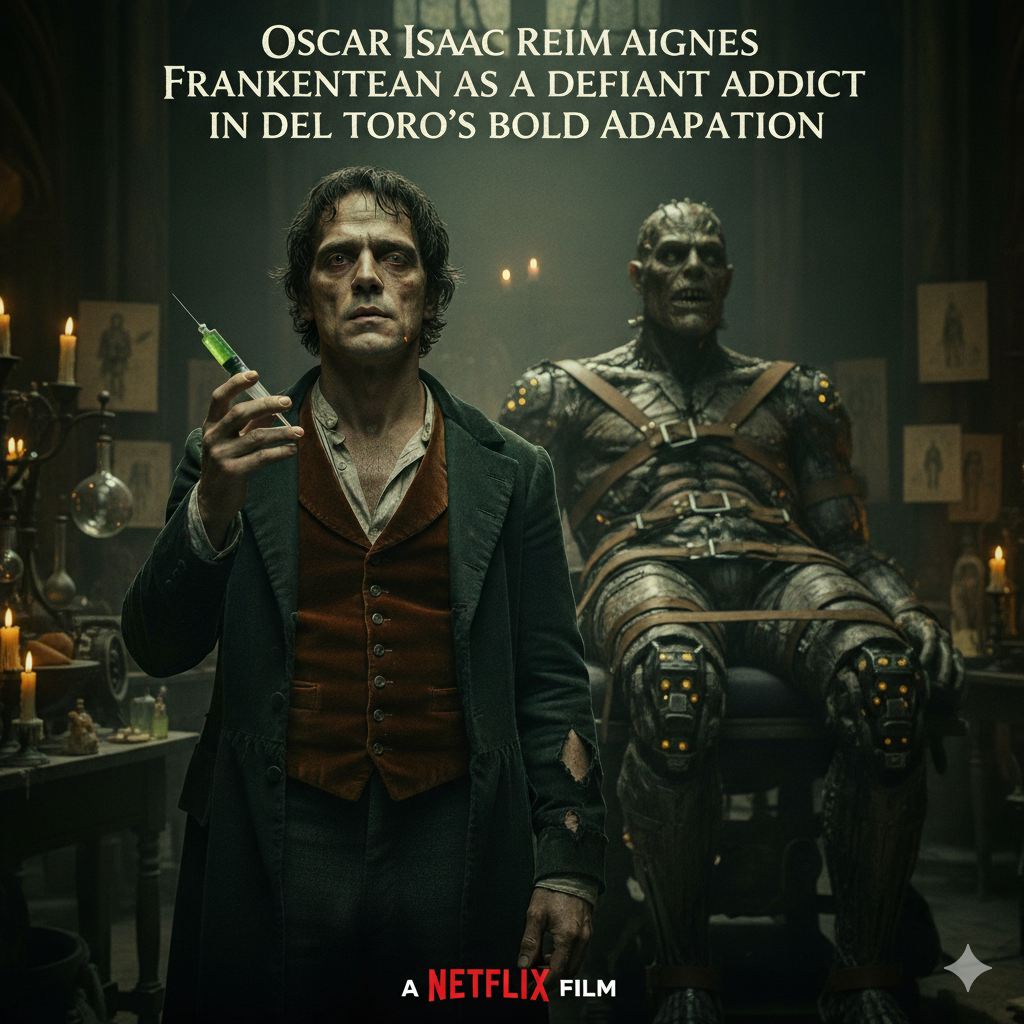
LOS ANGELES—Oscar Isaac, the chameleonic actor whose brooding intensity has defined a generation of cinematic antiheroes, graces the cover of GQ’s December 2025/January 2026 issue as a Leading Man of the Year. In a riveting interview with GQ culture director Alex Pappademas, Isaac pulls back the curtain on his transformative turn as Victor Frankenstein in Guillermo del Toro’s long-gestating adaptation of Mary Shelley’s gothic masterpiece. Set for release next year, the film promises a feverish, emotionally raw reimagining that blends Mexican melodrama with Taoist philosophy, positioning Isaac’s Victor not as a mad scientist, but as a rage-fueled artist grappling with inherited demons.
The collaboration between Isaac and del Toro, both sons navigating the shadows of their fathers, ignited over plates of Cuban takeout at del Toro’s home. “I’m making Frankenstein, and I think you need to play Victor,” del Toro told him, handing over Shelley’s novel alongside the Tao Te Ching. What followed was a tear-streaked script workshop in New York, where the duo dissected themes of forgiveness and fractured hearts. Isaac, drawing from his own religious roots and a penchant for “gullible belief,” infused Victor with the defiance of an addict—craving maternal solace through milk, his speeches laced with iambic pentameter for rhythmic ecstasy. “Defiance against circumstances, against themselves,” Isaac explains, likening the role to a punk rocker’s strut, inspired by Prince’s effortless command of the stage.
Yet amid the film’s Jungian depths and Catholic undertones, Isaac reveals a lighter side: Spanish quips on set to pierce the gloom, and echoes of his ska-band youth, where “once a rude boy, always a rude boy.” He even jokes about psychedelics as a shortcut to mental peace, underscoring his evolving take on forgiveness. “In order to survive and be human, we need to forgive,” he muses. “But it takes so much fortitude—or a lot of surrender.”Reflecting on Hollywood’s churn, Isaac tempers enthusiasm for a Star Wars return, quipping he’d consider it if Disney “doesn’t succumb to fascism,” a nod to recent network controversies like ABC’s brief suspension of Jimmy Kimmel Live! over pointed commentary. Personally, Isaac revisits 2017’s tumult—his mother’s death, Broadway’s Hamlet, and fatherhood—through wife Elvira’s unreleased documentary King Hamlet. “I feel compassion for this tempest-tossed person,” he says, embracing art’s alchemy in processing life’s wild synthesis.
With co-star Jacob Elordi as the creature, del Toro’s vision unearths a “loving universe” beneath ugliness, urging self-forgiveness into existence. Isaac’s Victor isn’t just a monster-maker; he’s a mirror for our own defiant inheritances. As awards season looms, this Frankenstein feels like a resurrection—one that proves Isaac’s enduring alchemy.